Researchers Say The "Fullness Hormone" Drops Over 55% After Menopause — Most Women Have No Idea
And The Drug-Free Patch 130,000 Women Past 50 Are Quietly Using To Take Back Control Of Their Cravings

Linda M. didn't realize how much of her brain had been hijacked by food until the day it went quiet.
For three years, the 62-year-old retired schoolteacher from Pittsburgh had been quietly losing a war she didn't tell anyone she was fighting. There were the 14 pounds that wouldn't budge no matter what she cut. There was the 3 p.m. cookie reach — every afternoon, like clockwork, the cabinet pulling her toward it before she'd even decided to walk over. There was the dinner-then-kitchen-visit pattern — finishing a full plate, sitting down to read, and somehow, an hour later, standing in front of the open fridge with no memory of how she got there.
And there were the jeans. A perfectly fine pair of jeans, folded in the back of her closet for three years, because she hadn't been able to button them since 2022.
She'd seen her doctor. Bloodwork was "normal." She'd tried the diet that used to work in her forties — the one where she just cut bread and the weight came off. It didn't anymore. She'd tried walking more. She'd tried smaller plates and bigger water bottles and skipping breakfast and skipping dinner.
Nothing. Or maybe two pounds, until she went to a birthday party and they came right back.
But Linda's "just getting older" wasn't random at all. And she's not alone.
Look, The Symptoms You Think Are Just "Getting Older"... Aren't
Most women past 50 have made peace with a list of symptoms their doctors keep calling "age-appropriate." But a growing body of research suggests these symptoms aren't random — they're the predictable downstream effects of one specific hormonal shortfall that almost no standard blood panel screens for.
If you've experienced at least three of these in the last twelve months, keep reading:
- Cravings that don't quiet — especially sweet ones, especially after 3 p.m.
- Belly fat that won't budge — no matter how clean you eat
- Eating past full — finishing the plate, then wanting more thirty minutes later
- Food noise — the constant background chatter about snacks, sugar, the next meal
- The diet that used to work in your forties suddenly doesn't
- Bloating, digestion that feels off, mood that swings on nothing
- The feeling you've quietly traded in your body for a stranger's
If three or more of those describe your last year, what you have is not "just menopause." It's a measurable biological shortfall in a hormone that controls every single one of those symptoms — and your "normal" labs almost certainly didn't test for it. (The standard panel doesn't screen for GLP-1.)
The Silent Hormone Crash Happening Inside Your Body
The hormone is called GLP-1 — glucagon-like peptide-1.
You've probably heard its name without knowing it. GLP-1 is the exact hormone Ozempic and Wegovy are designed to mimic. Those drugs work by artificially flooding the body with a synthetic version of it. The reason they work so well is that the hormone they're mimicking is the body's actual master switch for fullness and cravings.
Your body makes GLP-1 naturally — in tiny cells lining your gut called L-cells. When food reaches them, they release GLP-1, which travels to your brain and says, in effect: "You're full. The plate is enough. You can stop now."
The problem is what happens to that signal as you age.
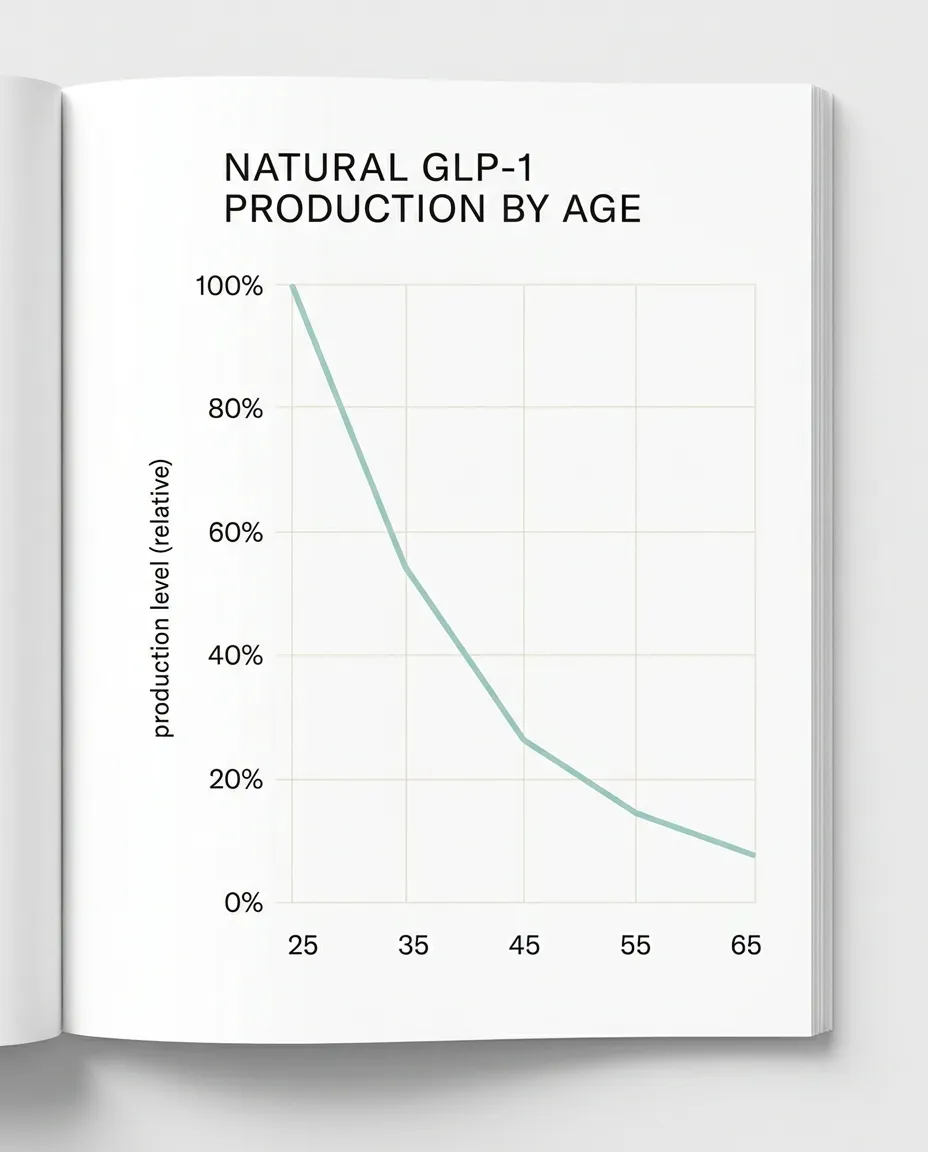
Researchers tracking GLP-1 across the lifespan have documented a steep, almost stair-step decline:
- By age 35: GLP-1 production is already down ~20% from youthful levels
- By age 45: down ~35%
- By age 55: down over 55%
- By age 65: the system is barely firing
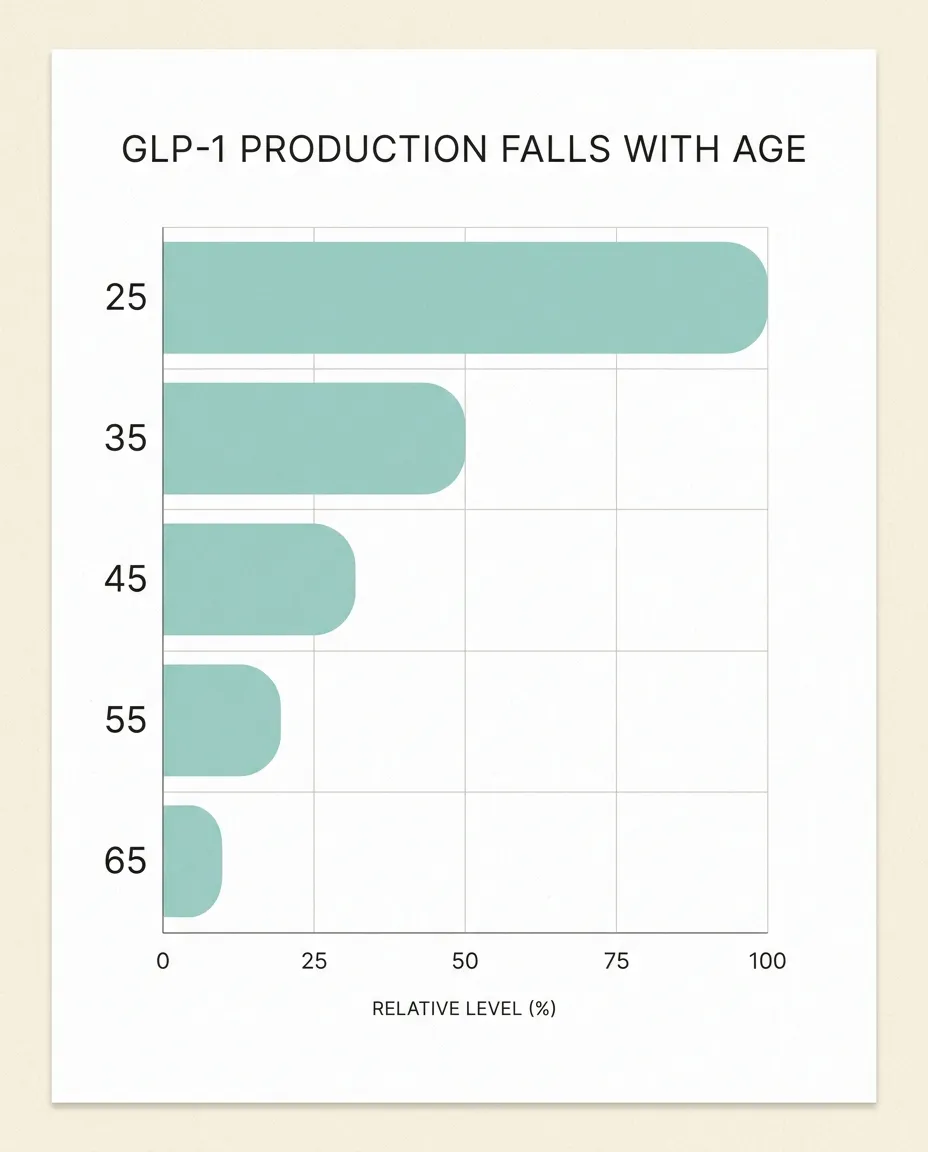
After menopause, the drop accelerates. Estrogen — which is already crashing — turns out to be one of the signals that keep L-cells sensitive. When estrogen falls, so does the sensitivity. The cell is still there. It just stops listening.
Here's what that deficit is doing inside your body right now:
- Cravings won't quiet — the "stop" signal never reaches your brain
- You eat past full — the plate finishes, the message doesn't arrive
- Belly fat refuses to budge — visceral storage is what the body does when satiety is broken
- Willpower feels broken — because it isn't willpower at all. It's biology.
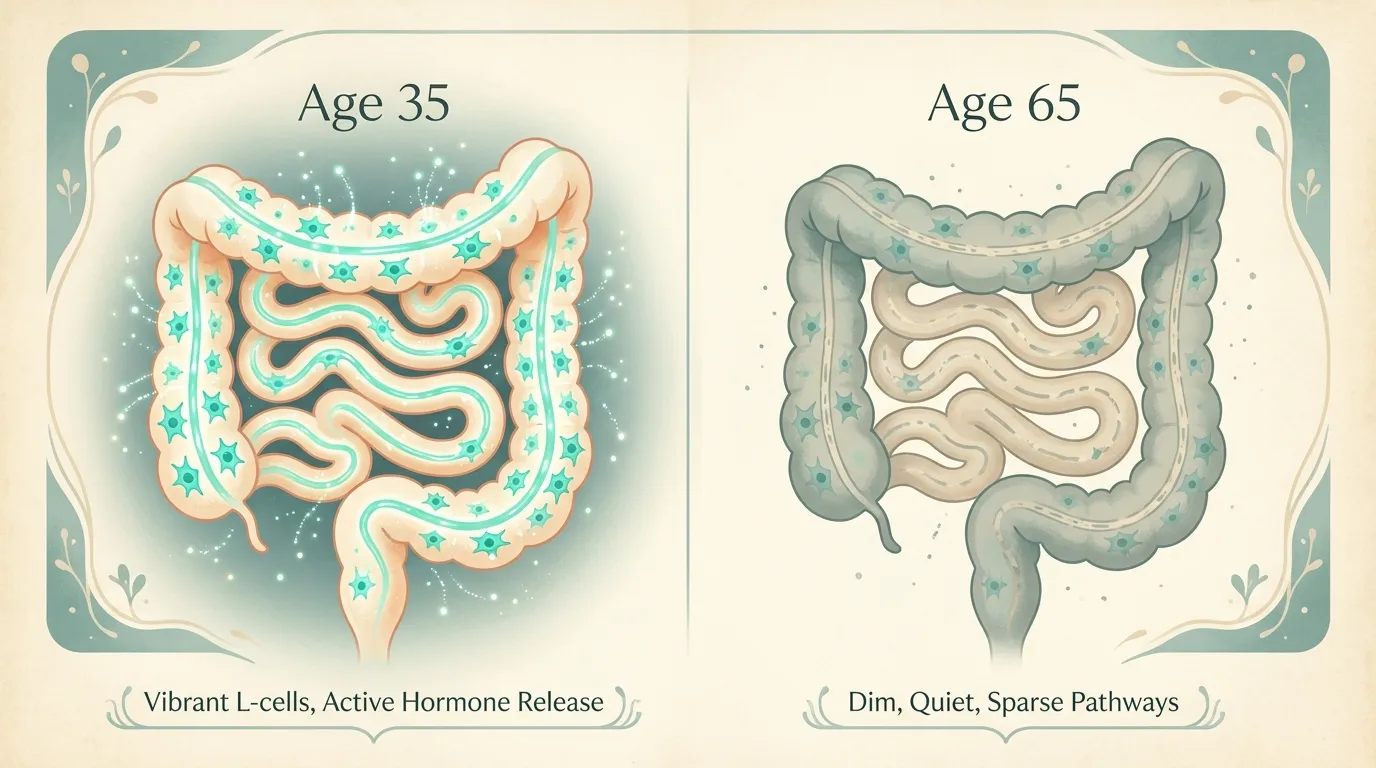
It's like driving a car when the gas gauge stopped working. You're still trying. The dashboard just isn't telling you the truth anymore.
This is what nobody told Linda. It's not her fault. Her body lost the signal.
The Fullness Signal Should Still Fire... But There's An Acid Wall Stopping Most Solutions
Here's what makes it even harder.
Researchers have known for years that a plant compound called Berberine — found in the berberis shrub — can signal L-cells to release more GLP-1. In dozens of trials, when Berberine reached the gut in adequate concentration, the L-cells responded. The cells aren't broken. They just need the right trigger.
So why isn't every woman past 50 cured by a bottle of Berberine pills from the health-food store?
Because there's a wall.
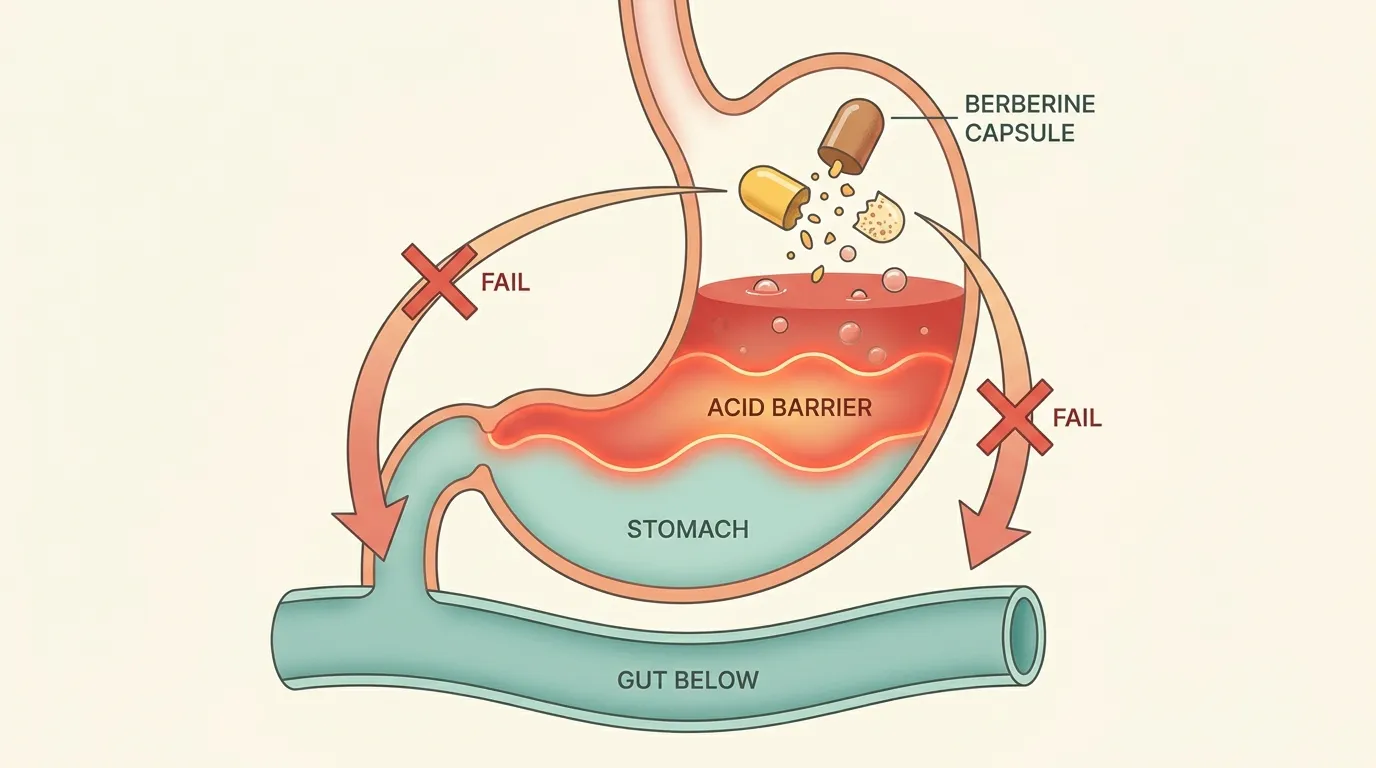
Stomach acid destroys oral Berberine before it ever reaches the L-cells. The compound is fragile. The acid is brutal. Studies have shown that the bioavailability of swallowed Berberine is so low it borders on negligible — most of the active ingredient is gone by the time it leaves the stomach.
It's like mailing a letter through a paper shredder. The envelope leaves your hand. Nothing useful arrives at the destination.
This is why the things women past 50 are told to do keep failing:
- Calorie counting — doesn't replace the missing hormone. You can starve and still have screaming cravings.
- Keto / low-carb — worked at 40, stops working at 55. Without GLP-1, the satiety isn't there.
- The gym — helps the heart. Doesn't restart the fullness signal.
- Berberine pills from the health store — the right compound, destroyed before delivery
- Probiotics, detox teas, diet shakes — treating symptoms, not cause
These solutions don't fail because you failed. They fail because they can't get through the wall.
The Discovery That Could Change Everything
This is where Linda's story takes the turn that might change yours.
After years of just dealing with it, Linda found something her sister had quietly been using — and her sister was the one in the family who'd always struggled hardest with weight.


The second insight was about concentration. Most Berberine at the health-food store isn't just poorly delivered — it's also underdosed. The doses studied in successful trials were several times higher than what's sitting on the supplement aisle. Most over-the-counter Berberine is like watered-down soap pretending to be pharmaceutical strength. The label looks right. The actual potency isn't there.
So how do you actually get this into a 62-year-old woman's body without losing 80% of it to stomach acid?
The Two-Part Approach Quietly Working For 130,000 Women Past 50
Remember Linda? Her sister wasn't taking pills.
She'd quietly been wearing a small patch.
The insight that drove the formulation was this: activating GLP-1 is only half the battle. The other half is keeping it active throughout the day. If you spike the hormone for an hour, cravings return by mid-afternoon. The real-world need is a steady, daylong signal.
That requires two active ingredients working together:
But ingredients aren't enough. Delivery still matters.
The breakthrough was transdermal delivery — the same technology used in nicotine patches and hormone replacement therapy. Actives absorb directly through the skin into the bloodstream and bypass the stomach entirely. The acid wall is no longer a problem because the letter never goes through the shredder.
The engineering challenge was getting the Prebiotic molecules small enough — under 1,000 Daltons — to actually penetrate skin. Most "GLP-1 patches" on the market skip this step. Their Prebiotic molecules are too large; they sit on the surface and do nothing. The molecular-weight piece is the part the labels rarely mention.
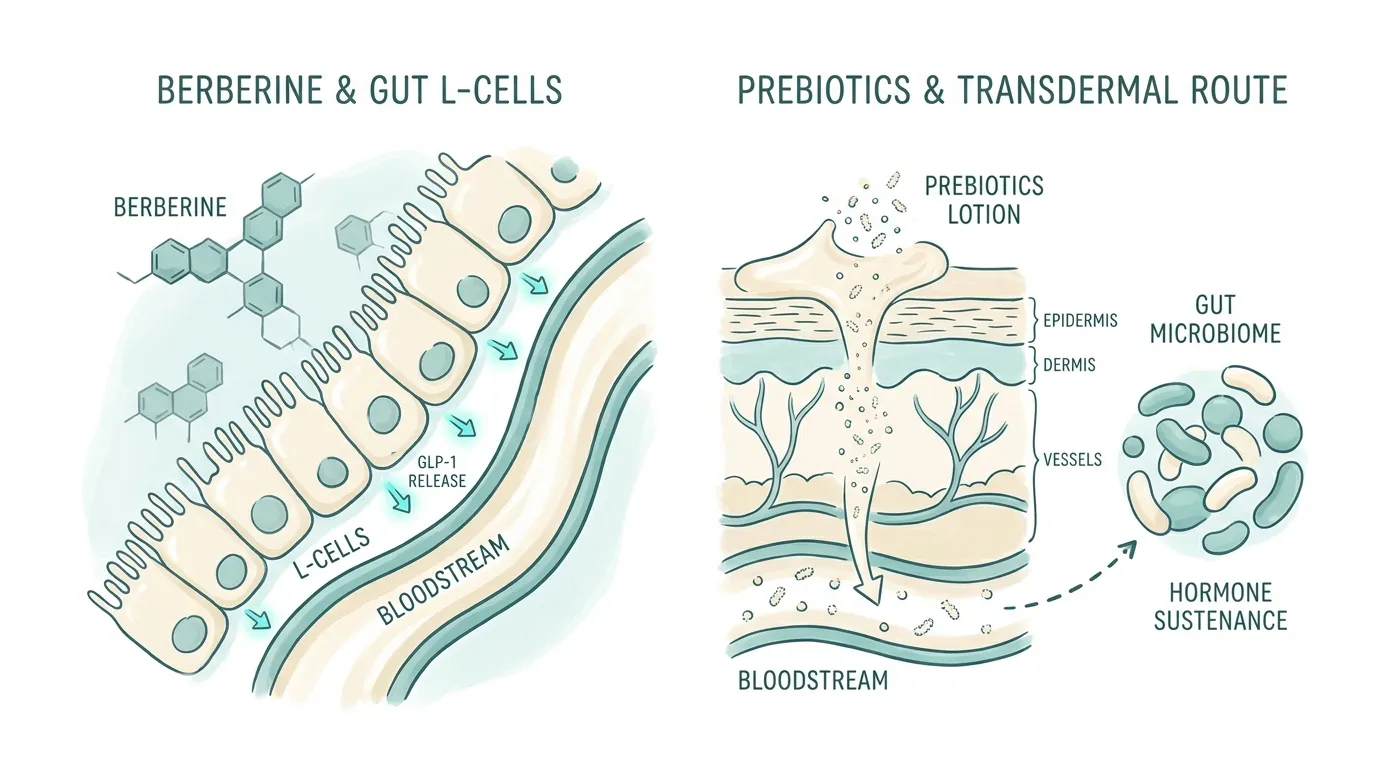
Together they're like a one-two punch the acid wall can't stop.
— Margaret R., 71
While women like Margaret were spending thousands on bandaids, the actual problem kept getting worse.
Finally, A Patch Designed For The Post-Menopausal Body
Remember that research?
One company took that exact approach and built around it.
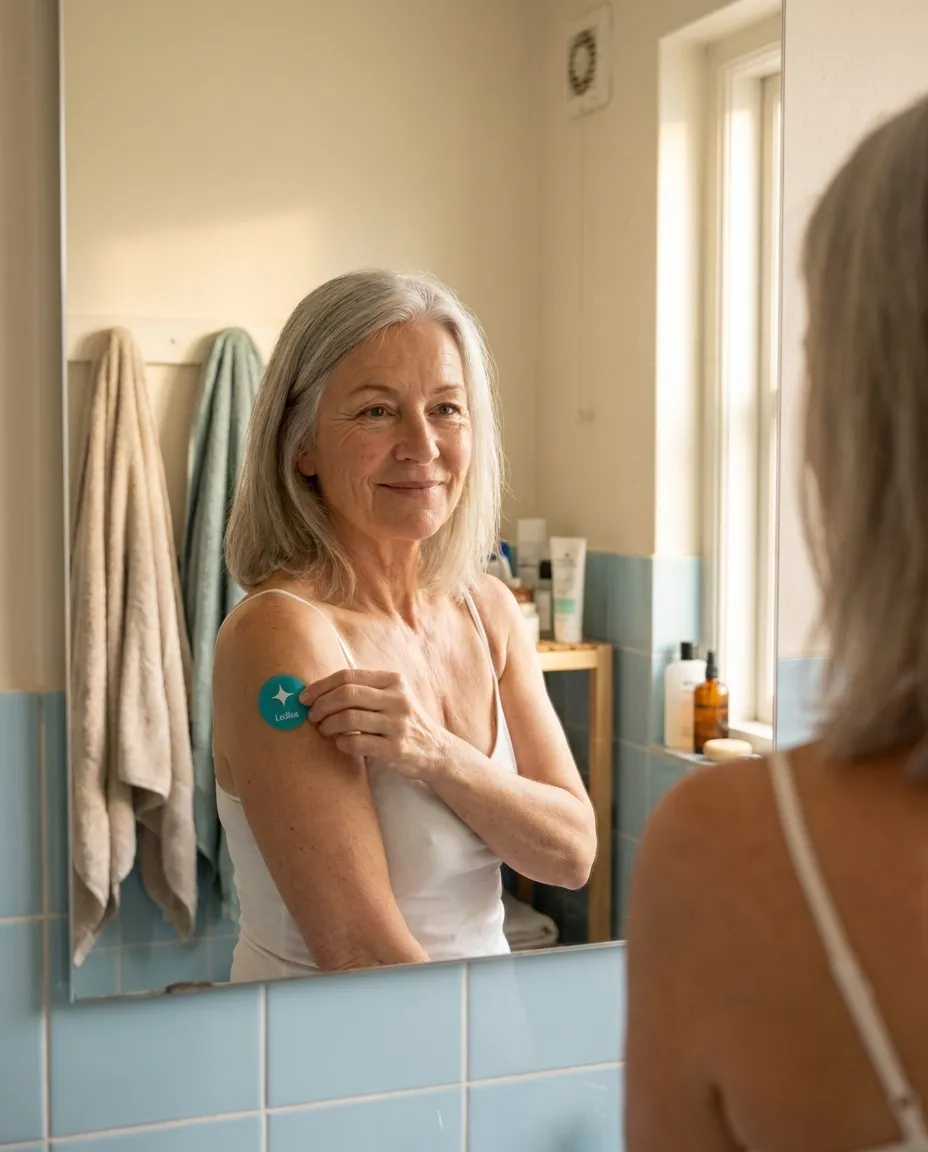
It's called Ledisa™ GLP-1 Support Patches — and over the last eighteen months, more than 130,000 women past 50 have quietly ordered them.

It is, as far as we can tell, the first commercial patch that pairs both halves of the formula — concentrated Berberine plus correctly-sized Prebiotics — with the transdermal delivery that actually gets them through. Most competitor patches skip the molecular-weight engineering. Most oral supplements skip the delivery problem entirely. Ledisa does neither.
Real Women, Real Results
"I'd given up. The diet that used to work in my forties stopped working at 54. By 64 I was just... resigned. About six weeks in, I walked past the bakery on Maple Street and realized halfway home I hadn't even looked in the window. That was the first time I knew something was actually different."
"The thing I noticed first wasn't the scale. It was falling asleep without snacking. I used to bring something to bed with me — a cookie, a handful of nuts, anything. After about three weeks on the patch I just... stopped. Didn't think about it. My husband asked if I'd quit. I had, and I hadn't even noticed."
"I'm not going to give you a number. What I'll tell you is that the jeans I'd kept in the back of the closet for four years buttoned in November. I cried in the closet. The brain finally went quiet — that's the part nobody warned me about."

Here's What Nobody Tells You About The First Two Weeks
This isn't a 24-hour fix. Anybody promising you that is selling you the same thing the diet industry has been selling you for forty years.
The honest timeline, based on what women report:
- Week 1–2: Cravings start quieting. The 3 p.m. reach becomes less automatic. Most women report this is the first thing they notice.
- Week 3–4: Jeans fit looser. The dinner-then-fridge-visit pattern fades.
- Week 6–8: Steady, visible body changes for most women who stay consistent.
- Week 12:"I feel like myself again."
The hormone went quiet over decades. Restarting it takes weeks. The 90-day window is not a marketing gimmick — it's the actual physiological recalibration period the science suggests.
 Try Ledisa Risk-Free for 90 Days →
Your Body Has Been Trying To Tell You Something
The symptoms you've been calling "just menopause"? They aren't. They're warning signs:
- The hormone signal stays quiet
- Belly fat keeps accumulating in the only place after-50 fat accumulates
- The diet that "should work" keeps not working
- The mirror keeps showing someone you don't recognize
Imagine, for a minute, what the other side of this looks like.
Waking up not thinking about food first. Walking past the bakery without the pull. Finishing dinner and walking away from the kitchen — without the kitchen visit two hours later. Buttoning the jeans you've kept in the back of the closet for three years.
That isn't a fantasy. That's just what happens when the missing hormone comes back online.
 Try Ledisa Risk-Free for 90 Days →
The Day Linda Stopped Waiting
Linda thought about it for a week. Then she ordered.
Ten days later, the 3 p.m. cookie reach hadn't happened twice in a row. She didn't notice until her husband pointed out the package of Pepperidge Farm Milanos in the pantry was still nearly full.
Three weeks later, she finished dinner and didn't visit the kitchen. She sat through an entire episode of her show without thinking about food.
Twelve weeks later, she pulled the jeans out of the back of the closet and they buttoned.

Individual results may vary.
Try Ledisa Risk-Free for 90 Days →It's Time To Take Back Your Body
Here's the choice in front of you, plainly.
The hormone crash isn't going to fix itself. It's not "just menopause." It's a measurable, biological shortfall — and after 50 it gets worse with every year you wait.
You can keep waiting. Keep buying smaller plates. Keep blaming yourself for cravings that aren't a willpower problem. Keep buying the next supplement that gets destroyed by stomach acid before it gets anywhere useful.
Or you can fix the actual problem.

The 90-day money-back guarantee makes the decision low-stakes. Cravings don't quiet? Appetite doesn't calm? Clothes don't fit looser? Send it back. Full refund.
The science suggests 8–12 weeks for the body to recalibrate the GLP-1 system — and most women on the company's site end up choosing the 6-month bundle for exactly that reason. It works out to roughly $0.60 a day.
Don't wait another season. Your body is begging you to listen.
Control Your Cravings. Transform Your Body. →1. Och A, Och M, Nowak R, Podgórska D, Podgórski R. Berberine, a herbal metabolite in the metabolic syndrome: the risk factors, course, and consequences of the disease. Frontiers in Pharmacology, 2023. PMID: 37921026.
2. Tajmohammadi A, Razavi BM, Hosseinzadeh H. Silybum marianum (milk thistle) and its main constituent, silymarin, as a potential therapeutic plant in metabolic syndrome: A review. Phytotherapy Research, 2018. PMC7140758.
3. Centers for Disease Control and Prevention (CDC). Adult Obesity Facts — NHANES.cdc.gov/obesity/adult-obesity-facts.
4. World Health Organization. Obesity and overweight — Fact sheet.who.int/news-room/fact-sheets/detail/obesity-and-overweight.
Individual results vary. A healthy diet is necessary to achieve and maintain weight loss. These statements have not been evaluated by the Food and Drug Administration. This product is not intended to diagnose, treat, cure, or prevent any disease. Patches are not a replacement for or medical equivalent to medical treatments. Special discount is valid only on first delivery of a new Ledisa subscription. Subscription renews every 30 days at the discounted rate listed at checkout.